
Did you know that nearly 75% of Americans think freedom of speech is key to democracy? This shows how important Freedom of Speech is to our society and its fight for civil rights. It’s not just a legal rule; it shapes our community and how we communicate.
But, there’s a fine line between saying what we think and being responsible. I’ll look into the deep questions around Freedom of Speech. We’ll explore its history and the legal limits that have been set. This will help us understand the importance of speaking responsibly in a diverse world.
Key Takeaways
- The First Amendment, adopted in 1791, serves as the foundation for U.S. Freedom of Speech.
- Significant Supreme Court cases have defined the boundaries and limitations of protected speech.
- True threats and fighting words are exceptions that do not receive First Amendment protections.
- Understanding harassment under the First Amendment is key for safe schools.
- The balance between free expression and responsible communication is vital in diverse communities.
Understanding Freedom of Speech and Its Legal Foundations
The First Amendment is key to understanding freedom of speech in the U.S. It was adopted in 1791. It says “Congress shall make no law…abridging freedom of speech.” This protection goes beyond just talking, covering many ways people express themselves.
The U.S. Supreme Court has been very important in explaining what this amendment means. They have defined what kinds of speech are protected over time.
The First Amendment and Its Provisions
The First Amendment protects many types of speech, from political talks to art. Important cases have shown what this amendment covers. For example, in *Tinker v. Des Moines* (1969), the Court said students have free speech rights in schools.
In *Texas v. Johnson* (1990), the Court said even acts like burning the flag are protected as symbolic speech. But, not all speech is protected. Things like defamation and speech that incites violence are not.
Historical Context of Free Speech in the U.S.
The history of freedom of speech in the U.S. shows how it has grown. It started with the First Amendment and became even more important during the Civil Rights Movement of the 1960s. Activists fought for racial equality and justice back then.
Supreme Court decisions like *NAACP v. Alabama* (1958) and *Edwards v. South Carolina* (1963) showed how important speech and assembly are. These rulings made it clear that freedom of speech is not just a legal right. It’s also a way to fight for civil rights and protect different opinions.
Freedom of Speech: Limits and Exceptions
Freedom of speech is a key part of American life, but it has its limits. Knowing these limits helps us understand how laws affect our right to speak freely. The Supreme Court has set important rules about what speech is protected and what isn’t.
Recognized Limitations to Freedom of Speech
There are several limits to free speech, like obscenity, fighting words, and threats. The Supreme Court said in Brandenburg v. Ohio that speech that could lead to violence isn’t protected. Cases like Wisconsin v. Mitchell show that hate speech can be used in sentencing, even if it’s not punishable itself.
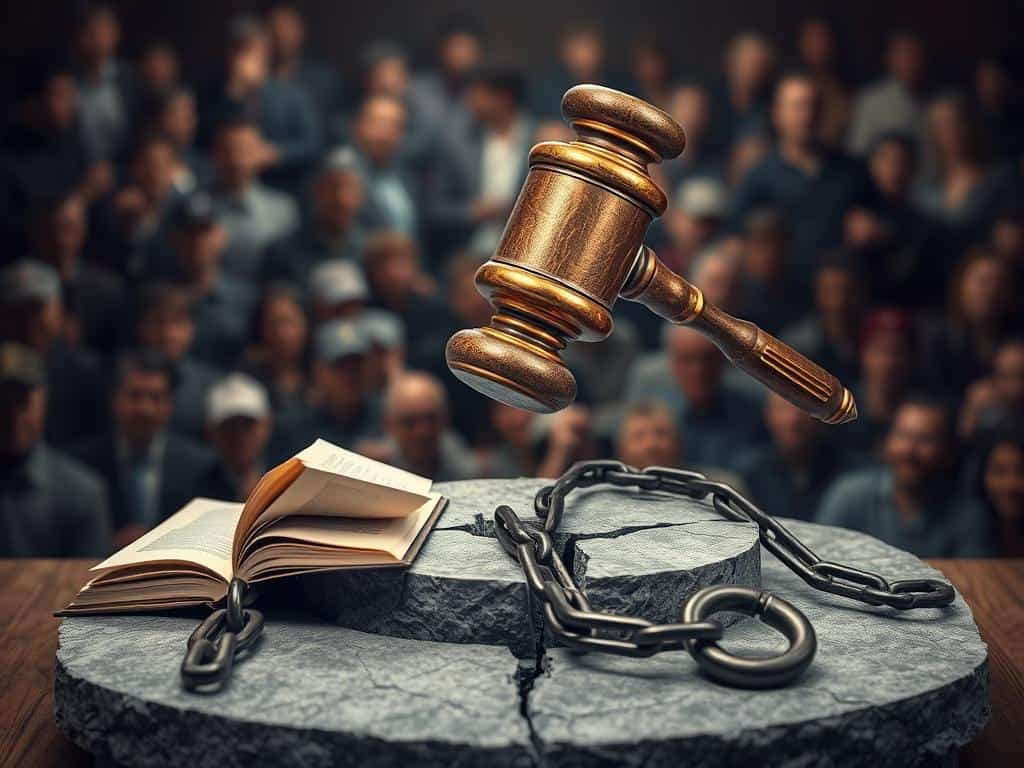
What we say and how we say it matters a lot. But, big court decisions help us know what’s legal. False statements, for example, can be limited, as seen in United States v. Alvarez. Defamation laws also have strict rules, like proving “actual malice” for public figures, as in New York Times v. Sullivan.
Significant Supreme Court Cases and Their Impacts
Many Supreme Court cases have shaped our understanding of free speech. Miller v. California set a test for what’s considered obscene. It said only extreme content is not protected. On the other hand, Cohen v. California in 1971 said that just being rude isn’t enough to ban speech.
These decisions keep changing how we see free speech. They balance protecting our rights with keeping society safe. Cases about commercial speech show how these rules apply to business talk too. As laws evolve, so does our conversation about free speech.
Conclusion
Freedom of Speech is more than just a law in America. It’s a key part of our democracy. The First Amendment ensures we can talk openly, even when it’s hard.
But, there are big challenges with free speech. These challenges have been pointed out by wise judges and thinkers over time.
Justice Oliver Wendell Holmes said that even tough speech is important. He believed it helps us find the truth. This shows us that we need to respect and listen to each other.
Today, we face problems like online bullying and fake news. We must create a space where everyone can share their views safely.
My journey into this topic has shown me something important. We all have a role in making sure our speech is ethical. By working together, we can keep our freedom to speak and listen alive.
This way, we can balance our right to express ourselves with the need to respect others. Freedom of Speech is a powerful tool for growth and understanding in our world.
