
Did you know that research on AI in healthcare has grown a lot in recent years? This growth shows a big change in the medical world. Experts like Ray Kurzweil think we’re getting close to a time when AI will be smarter than humans by the mid-2000s.
AI in healthcare is changing how doctors and patients interact. It’s making some people wonder if it’s more efficient and ethical.
The FDA-approved Di Vinci robotic system is a great example. It has changed surgery worldwide for over 20 years. AI is also improving diagnosis and radiology with its advanced technology.
But, we need to think about the good and bad sides of AI in healthcare. It’s important to consider how it affects patient care, privacy, and the doctor-patient relationship.
Key Takeaways
- The volume of AI-related healthcare research has significantly increased in recent years.
- Technological singularity could see AI surpass human capabilities by 2040-2050.
- The Di Vinci surgical system showcases AI’s application in improving surgery.
- Machine learning is changing how we manage patients, like in diagnosing back pain.
- There are worries about AI’s impact on the doctor-patient relationship and health record security.
The Rise of AI in Healthcare
AI is changing medicine in big ways, thanks to new tech. It helps doctors make quick, smart choices by analyzing lots of data. Knowing how AI works is key to seeing its value in treating patients.
Understanding Artificial Intelligence in Medicine
AI in medicine includes machine learning and natural language processing. These tools help doctors understand data better. Machine learning finds patterns in data to aid in making decisions. Natural language processing makes sense of clinical texts and patient records.
This combo speeds up AI use in hospitals. It helps doctors spot diseases more accurately. This leads to better care for patients.
Current Applications of AI in Diagnosis and Treatment
AI is used in many healthcare areas today. It’s very good at certain tasks, even better than humans. For example, AI can spot breast cancer with 90% accuracy, beating doctors at 78%.
AI also cuts down on mistakes in screenings. This means treatments can be more precise. It’s a big win for patient care.
AI helps with personalized medicine and managing health better. It even offers virtual health assistants to patients. This tech aims to save money and improve care quality, aiming to save USD 150 billion by 2026.
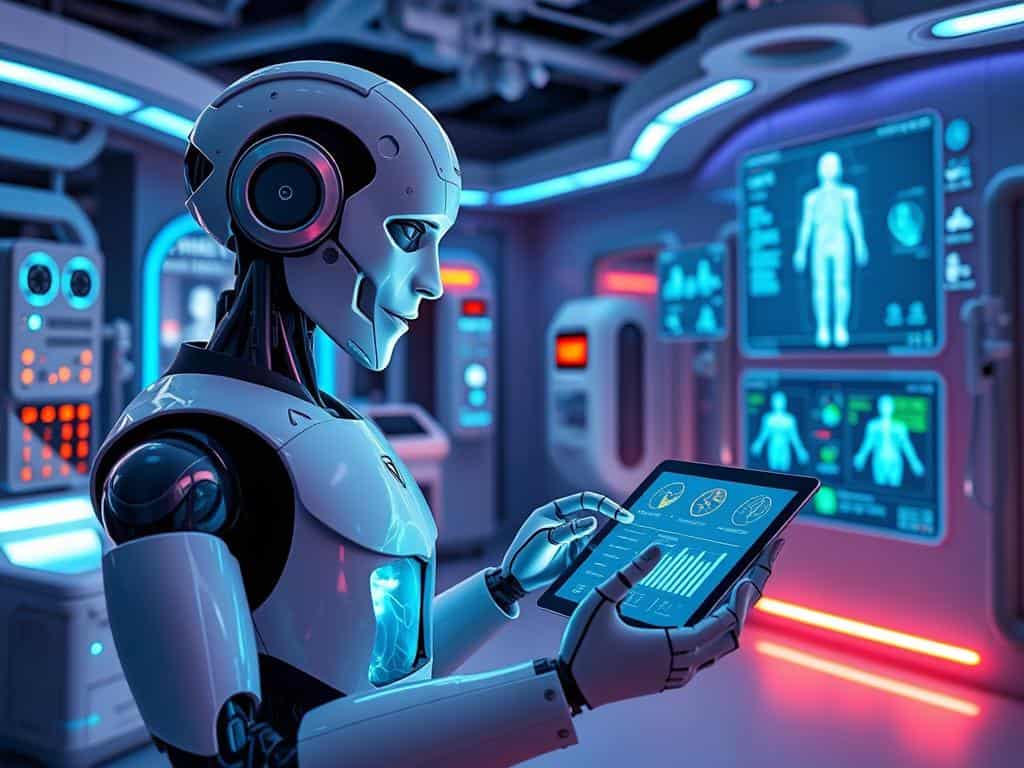
AI in Healthcare: Transforming Patient Experience
Technology in healthcare has opened new ways to improve patient experiences. AI tools are making care more efficient and changing patient care. Medical robots and AI systems can automate tasks and give insights, but keeping the human touch is key. Machines can’t replace emotional support and patient engagement.
The Human Touch in a Tech-Driven World
AI’s role in healthcare shows a balance between technology and human connection. A study found patients often prefer AI chatbots over doctors, showing a change in healthcare expectations. AI can predict outcomes and speed up processes, but it can’t match the compassion of doctors.
The American Medical Association says AI should help, not replace, the human touch. This focus on “augmented intelligence” is important.
Case Studies of AI Applications in Clinical Settings
Looking into clinical settings, I found many examples of AI’s impact. At the Mayo Clinic, AI identified at-risk individuals before symptoms appeared. This shows AI’s role in proactive care.
AI models have also outperformed humans in predicting survival rates and finding medical issues in images. These examples show AI’s power to improve patient outcomes and make healthcare more efficient. The future of AI in healthcare looks promising for changing patient interactions and care.
