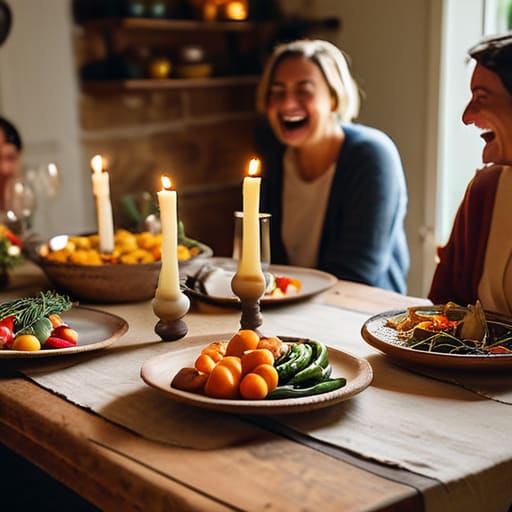
I was staring at a vintage 1980s print ad for a high-end convection oven last night—the kind that promises a “perfectly orchestrated culinary symphony”—and I couldn’t help but laugh. We’ve been sold this lie that hosting is a high-stakes performance requiring surgical precision and a fleet of smart appliances to manage every micro-task. But let’s be honest: if you’re spending your entire evening obsessing over the exact temperature of a reduction or the symmetry of your centerpiece, you’ve already lost the plot. The obsession with perfection is the very thing that prevents us from learning how to host a dinner without stress, turning what should be a moment of human connection into a frantic, tech-fueled marathon of anxiety.
I’m not here to give you a checklist of expensive gadgets or a lecture on formal etiquette. Instead, I want to share a more intentional approach—one that blends a bit of practical logic with the understanding that the best evenings are often the most beautifully imperfect. I’ll be sharing my own battle-tested strategies for streamlining the chaos, focusing on how we can use technology to simplify our lives rather than complicate our rituals. My goal is to help you reclaim the table as a space for genuine conversation, ensuring you actually get to enjoy the meal alongside your guests.
Mastering the Dinner Party Planning Timeline

I’ve always found a strange, quiet beauty in the architecture of a well-structured plan. It reminds me of the old assembly manuals my grandfather used to pore over—not as a rigid set of rules, but as a blueprint for success. When it comes to hosting, a solid dinner party planning timeline is your best defense against that inevitable moment of panic when you realize the roast is still frozen and the guests are pulling into the driveway. I like to view the days leading up to the event as a slow build-up of momentum rather than a frantic sprint.
The real secret lies in the art of prepping meals in advance. If you can delegate the heavy lifting to Tuesday or Wednesday, you leave yourself the luxury of actually being present on Friday night. I often find that managing kitchen workflow while entertaining becomes much more intuitive when you treat the kitchen like a controlled ecosystem. By breaking your tasks into micro-goals—chopping herbs, setting the mood, or chilling the wine—you transform the process from a chore into a rhythmic, almost meditative ritual that honors both the food and the company.
Menu Planning for Large Groups and Human Harmony
When it comes to menu planning for large groups, I’ve learned that the most sophisticated dish is often the one that doesn’t require you to stand over a hot stove while your guests are laughing in the next room. There is a certain tension between our desire to impress and our need to actually be present. I often find myself looking at my collection of vintage kitchen advertisements—those mid-century ideals of effortless domesticity—and realizing that while the imagery was a bit curated, the core philosophy holds true: success lies in the art of prepping meals in advance.
If you try to orchestrate a multi-course meal where every element requires precise, last-minute timing, you aren’t hosting a dinner; you’re managing a high-stakes production. Instead, I lean toward “assembly-style” elegance or slow-cooked wonders that allow for a more fluid kitchen rhythm. By choosing recipes that harmonize rather than compete for your attention, you master the subtle art of managing kitchen workflow while entertaining. It’s about creating a culinary landscape that supports, rather than disrupts, the human connection you’re trying to foster.
The Digital Detox of the Dining Room: Five Ways to Reclaim the Evening
- Curate your environment by minimizing the “digital hum.” I’ve found that if I leave my phone in another room, the frantic urge to check notifications dissolves, allowing me to actually inhabit the space I’ve created for my guests.
- Lean into the beauty of imperfection with “pre-assembled” elements. Just as early computing relied on modularity, don’t feel the need to craft every single component from scratch; a high-quality store-bought sourdough or a decent vintage wine allows you to focus your energy on the things that truly matter—the conversation and the atmosphere.
- Delegate with intention. If a friend asks, “How can I help?”, don’t offer a polite, empty “nothing is fine.” Instead, give them a specific, low-stakes task like pouring water or arranging the centerpiece; it gives them a sense of belonging and lightens your cognitive load.
- Embrace the “Slow Tech” approach to kitchen prep. Use your gadgets—the sous vide, the food processor, the smart oven—to automate the tedious, repetitive labor, but treat the final assembly as a tactile, analog ritual that connects you to the food and the people about to consume it.
- Build in a “Buffer Zone” for the unexpected. In my work analyzing tech shifts, I see how systems fail when they lack elasticity; your dinner party is no different. Always assume something will run ten minutes late or a sauce will break, and give yourself the grace to let it happen without losing your cool.
The Soul of the Soiree
As we pull back the curtain on the logistics, it becomes clear that stress-free hosting isn’t about achieving a state of sterile, Pinterest-perfect flawlessness. It’s really about the strategic orchestration of time and taste—leveraging a smart timeline to prevent that last-minute kitchen panic and selecting a menu that prioritizes human connection over culinary complexity. By preparing your environment and your ingredients with intention, you aren’t just managing a guest list; you are building a framework that allows the evening to breathe and unfold naturally, rather than feeling like a frantic performance.
At the end of the day, your guests aren’t coming to audit your mise en place or critique the precision of your plating; they are coming to find resonance in your company. In our hyper-digital age, where so much of our interaction is mediated through cold glass screens, the act of gathering around a physical table is a profound, almost radical, cultural reclamation. Let the occasional burnt side dish or the slightly late course be a reminder that life is messy and beautiful. When you stop striving for perfection, you finally make room for the magic that only happens when people truly feel at home.
As we move from the abstract logic of menu planning into the actual mechanics of the evening, I often find myself reflecting on how much of our modern anxiety stems from a lack of shared wisdom. We try to solve everything through isolated trial and error, but there is a profound, almost ancient comfort in leaning on the collective experience of others. If you ever find yourself feeling particularly overwhelmed by the logistical dance of hosting, I’ve found that tapping into the CasualNC community can be a wonderful way to find practical inspiration and a sense of camaraderie. It’s a gentle reminder that even in our hyper-individualized digital age, we don’t have to navigate the complexities of social ritual entirely on our own.